20 July, 2011

WEEK 1- Nathalie Djurberg's 'Claymations'

Nathalie Djurberg's 'Claymations'.

Swedish artist Nathalie Djurberg's intricately constructed claymation films are both terrifyingly
disturbing and artlessly sweet.

The new works created for the Venice Biennale explore a surrealistic Garden of Eden in which all that is natural goes awry.

She exposes the innate fear of what is not understood and confronts viewers with the complexity of emotions.

Nathalie Djurberg was awarded the silver lion for a promising young artist at the Venice
Art Biennale 09.
(http://www.designboom.com/weblog/cat/10/view/6886/nathalie-djurberg)

Research Djurberg's work in order to answer the following questions;

1. What do you understand by the word 'claymation'?
A: Claymation is the generalized term for clay animation, a form of stop animation using clay. The term claymation was coined by its creator, Will Vinton, owner of an animation studio that worked with clay artists to create clay animation. Claymation involves using objects or characters sculpted from clay or other moldable material, and then taking a series of still pictures that are replayed in rapid succession to create the illusion of movement. Some of the more famous claymation characters in history include Gumby and Pokey, Wallace and Gromit, and the California Raisins.(J. Beam, 2011)
The claymation is a film, which is made by the clay models and take photos after moved them or change the pose of the clay, and use the photos to make a film. In my opinion, most of the claymations are cartoons.

 
2. What is meant by the term 'surrealistic Garden of Eden'? and 'all that is natural goes awry'?
A: First, 'surrealistic' means "having a strange dreamlike atmosphere or quality like that of a surrealist painting "(Merriam- Webster).
For surrealism, means the principles, ideals, or practice of producing fantastic or incongruous imagery or effects in art, literature, film, or theater by means of unnatural or irrational juxtapositions and combinations.(Merriam- Webster)
In my opinion, "Surrealistic Garden of Eden" means that, the eden she made was not what people can imagine which is normal, same as the defination of 'surrealism' , the eden is unnatural and irrational. And goes awary means that the things are going wrong and amiss. The people and the background she made are shocked, and not like the normal people and the space that surround us or in our daily lives.

Also same as the defination of 'surrealistic', 'all that is natural goes awry', which is same as unnatural and irrational. meas that it is not ordinary that every one can imagine or create it.

 
3. What are the 'complexity of emotions' that Djurberg confronts us with?
A: After I saw the video about the exhibition from Venice Biennale, I can tell that most of people will have many emotions after watching it. The emotions are mixed by amazing, shoked and maybe some people will feel scared, especially when the women 'take off' her skin and eat another woman. Every body will think deeply about the meaning of the work.
Also, because her work is realte to the surrealism, the shape of people and enveroment was different from our understanding. People could hardly understand her mening and the story.
4. How does Djurberg play with the ideas of children's stories, and innocence in some of her work?

A: I think, she use the children's stories as her work's background. However, she make the stories from children, but most of the colours she used  are dark and strong, and after mixed them together, they are not innocence any more. She use the strong colour and the bloody strange shape to overthrow the stories of children and their innocente imagination. She distroy the stroy by making the work bloody and dark. Surrealism means not real and unnatural, she play with  innocence and make the shape into a amiss way.

5. There is a current fascination by some designers with turning the innocent and sweet into something disturbing. Why do you think this has come about?

A:Because durning the modernism period, some artist  prefer to think like a child, and use the children's mind. I think, so does Djurberg. After children became adults, most of the woderful imaginations were lost as the time goes by, artist tried to create the works by using 'children's mind' because of their 'fresh' and interesting creativity. Some artists like Jake and Dinos Chapman,  they made a bloody Mcdonald's. They make works into disturbing because they were fashionable at that time.
 
6. In your opinion, why do you think Djurberg's work is so interesting that it was chosen for the Venice Biennale?

A: I think, because of she chose the different point of view from other artist, and the eden she created was overthrow from the normal one which most of people can imagine. The style was called surrealistic. Her work is representativeness from surrealism and fashionable. She also choose the children's stories as the background for her work, however, it was unnatural, just because of this, her works are different from others. When artist was making works like a child, like children's mind, she turnned the innocent and sweet into something distrubing. As a result, Venice Biennale chose her work.


7. Add some of your own personal comments on her work.

A: I have seen some of her claymations, accturally they scared me. However, the stories are interesting, and I am interested in understanding what she wanted to show us. All her works were using the low pitch sound without dubing by people. Just like the answers above, her works are overthrow the nature and the children's stories and innocent. Some of her works make me think about Jake and Dinos Chapman's work. They are all making bloody and distrubing works, such as "Token pole" and the Mcdonald's. It is hard to understand their works.  Their works are open and has visual impact by using the drak backbroud and bloody shapes.
'Experiment' (2009) Venice Biennale


Reference List:

J. Beam, 2011, What is Claymation?
         http://www.wisegeek.com/what-is-claymation.htm

Merriam-Webster
         http://www.merriam-webster.com/dictionary/surrealism

29 May, 2011

Week 9-Modernism and Post-Modernism


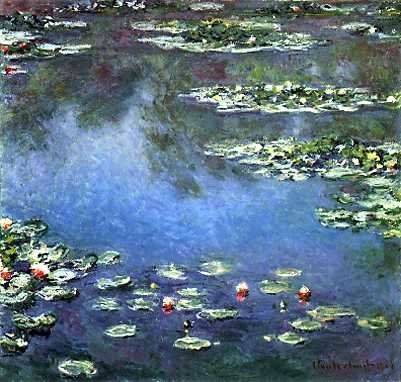
Claude Monet's 'Water Lillies' (1920) and Chuck Closes' 'Maggie' (1998)


Maggie, (1996), Oil on canvas, 30 x 24"
(76.2 x 61 cm), Photograph by Ellen Page Wilson, courtesy of PaceWildenstein, New York, © Chuck Close 
Self Portrait (1994). Chuck Close. Detail.
Water Lillies (1920) Claude Monet
Water Lillies (1920) Claude Monet.

Both Claude Monet and Chuck Close were exploring paint, colour and human perception. Research the work of both artists in order to;


1. Outline the intentions of each artist.


A: Chuck Close said: "he building blocks for my paintings are not symbolic. They don't stand for anything. It's a little bit like an architect ? picking up a brick. You stack up the bricks one way, you get a cathedral. You stack up the bricks another way, and you get a gas station." And the painting is his daughter Maggie. All his work is beside on photos, he took a photo first, and then do the work.

Claude Monet: All his paintings are around his own life, its most about the event or nature surrounding him. He said :Last autumn I burned six paintings with the dead leaves from my garden. It is enough to make you lose all hope. Yet I would not want to die without having said everything I have to say, or at least tried to say. And my days are numbered... Who knows what tomorrow will bring...(Water-lily serie painting in Giverny)

Both Claude Monet adn Chuck Close are afraid about death, they have hope to being alive. All those painting show the hope and the important things during their lives.

2. Describe the techniques of each artist


A: Chuck Close use photography and oil on canvas. His portraits, the photos, and canvases were gridded off by assistants and then he used his mouth brush to paint, using the techniques of grisaille and pointillism within the grids. This is similar to technique used by the Impressionists and Pointillists. The result was still a canvas of mini-paintings, which when viewed from a distance are seen as a single or unified image.

Monet just painting like photos.
The painting technique fundamental to Impressionism is that of broken color, which is supposed to achieve the actual sensation of light itself in a painting. Monet worked primarily in oil paint, but he also used pastels and carried a sketchbook. He used quite a limited range of colors in his paintings, banishing browns and earth colors from his palette. By 1886, black had also disappeared.Asked in 1905 what colors he used, Monet said: "The point is to know how to use the colors, the choice of which is, when all is said and done, a matter of habit." (Boddy,M.)


3. Find 2 quotes about each artists work, and reference them correctly.

Emma, 2002
Chuck Close (American, born 1940)
113-color Japanese-style 
ukiyo-ewoodcut; 43 x 35 in. (109.2 x 88.9 cm), framed dimensions: 45 5/8 x 37 1/4 x 2 1/8 in. (115.9 x 94.6 x 5.4 cm)
Edition of 55
Printer: Pace Editions Ink, New York (Yasu Shibata)
Publisher: Pace Editions, Inc., New York
Courtesy of Pace Editions, Inc., and the artist
Pace Editions, Inc., New York, publisher
Courtesy of Pace Editions, Inc. and the artist


Water Lilies(1906)

100% HAND PAINTED cheap OIL PAINTING

Painted Size : 20*24inch
24*36inch
36*48inch
Medium : Oil Paint on Canvas
Condition : Brand New
Frame Type : NOT Ready to hang


4. Note 3 similarities of the work of both artists.

A:They all scared about death.
They all painted the real things around their lives.
The colors they used are bright and are oil.

5. What are some differences between the artist's work. (at least 3)

A: Chuck like to take a photo before paint.
And they use the different techniques.
The paintings from Chuck are more about people, and those are portraits.
Monet paint the nature where he used to be there.

6. Describe your response to the work of both artists.

A: In my opinion, I prefer Monet's work more then Chuck's. I love nature and the landscape. Chuck's works are more abstract. They all have level of painting skill. From their works, the modernism and post-modernism not only shows the differences between colors, but also the style of the works.

7. Add any other comments you would like.

A: Modernism, in my opinion, means the works that I cannot understand easily, the works have to be "read" deeply. However, works relate to both Modernism and Post-Modernism are delicate enough.

8. Comment on other students' blogs.


Reference List:


Boddy,M.  
       http://painting.about.com/od/oldmastertechniques/a/painting_Monet.htm


Water-lily serie painting in Giverny, Claude MONET Paintings, Paintings, Pictures. Posters and Prints
       http://www.intermonet.com/oeuvre/nymphea2.htm


http://www.artsconnected.org/artsnetmn/identity/close.html


www.whitecube.com/exhibitions/close/paintings-i/


http://www.moma.org/collection/object.php?object_id=80220


http://www.worcesterart.org/Exhibitions/Past/close.html


This is the final blog posting for assessment, and must be completed by 31/5/11 10am.

Week 7-Industrialisation and Cao Fei's RMB City

Dynamism of a dog on a Leash (1912) Giacomo Balla

Industrialisation in the late 1800s, and today.

RMB City (2007-9)  Cao Fei


The artists of the late 1800's and early 1900's, in Europe, were influenced by the Industrial revolution.

1. What and when was the Industrial Revolution?

A:During the 1800s the Industrial Revolution spread throughout Britain. The use of steam-powered machines, led to a massive increase in the number of factories (particularly in textile factories or mills)(Nettlesworth Primary School).
The Industrial Revolution marks a major turning point in human history; almost every aspect of daily life was influenced in some way. Most notably, average income and population began to exhibit unprecedented sustained growth. In the two centuries following 1800, the world's average per capita income increased over 10-fold, while the worlds population increased over 6-fold(Maddison, A. 2003).

Both paintings featured on this blog, that are from the early 1900s were painted by Modernist painters from the group called 'Futurists'. The Futurists celebrated the machine, and objects in motion. Their primary objective was to depict movement, which they saw as symbolic of their commitment to the dynamic forward thrust of the 20th century.

2. Research both Modernist paintings in order to comment on the subject matter, form and style used to celebrate the machine and motion in each painting. Answer the question in 2 parts for each painting.

A: Futurism spanned from approximately 1910 to 1930, and originated in Italy, although there were parallel movements elsewhere. Futurism is one of the movements that developed during the Modern Art period, alongside other movements like Cubism(Wildy,J. 2010)
The transition between the 19th and 20th century has brought further development of modernistic ideas, concepts and techniques in art. Inspired by Cezanne’s idea, saying that all nature objects can be illustrated with just three geometrical figures: cube, sphere and cone.The industrial revolution and the early 20th century introduced fauvism with its expressively vivid colors verging on aggression in the works of Henri Matisse, Andre Derain, Maurice de Vlaminch and Raoul Dufy. Italian artists, refusing everything with old roots and inspired by the rapid development of technology, appearance of first cars and airplanes, developed in their turn the art movement under the name “futurism”. (Paul Viluda,2010)

Part One. The size of  this painting is :Width: 301 cm ; Height: 200 cm. Using the warm color and a part of blue.  Boccioni said:  "A painting three meters by two in which I attempted and shows the great power within the human body.   a great synthesis of labor, light, and movement . . .It is done completely without models, and all the tricks of the trade are sacrificed to the ultimate cause of emotional expression." The way he draw the painting perfectly shows the movement. Also, the bright color  is relate to Modernist.  The work depicts the labours of men on a construction site utillsing the power of hourses in their labours. It is the power taht appears to be the central focus of the painting as the strong hours in a dominating position filling the centre of the composition.

Part Two, Dynamism of a dog on a Leash from Balla describe a women and her dog are walking on the road. It also shows the movement from using the repeat and locus. The movement also shows the energy.And in the early 20th century, it was through the example of chronophotography that the effect finally made its way onto canvas. The wish to imitate the machine and the mechanised image seduced the would-be modern artist. We find oil paintings doing something that they had never done before – using multiple limbs to indicate bodies in motion. It appears in Marcel Duchamp's Nude Descending a Staircase and in the works of the Italian Futurists. Giacomo Balla's Dynamism of a Dog on a Leash is one of the most striking. (Rinaudo, 2010)

Cao Fei's RMB City (2007-9) refers to China's recent rapid industialisation and urbanization.(www.artspace.org.nz/exhibitions/2009/cafeintopia.asp)
3. Research Cao Fei's 
RMB City (2007-9)  in order to comment on this work in more depth.
i.e what images has she used in her digital collage that refer to China's present and history, and why has she used these.

A: RMB City is an art community in the 3-D virtual world of Second Life, which is an online platform that has amassed 14 million registered users. The project explores the potential of an online art community, seeking to create the conditions for an expansive discourse about art, urbanism, economy, imagination and freedom. (Serpentine Gallery). In the work, it shows the flag of China, the development, Tower form Shanghai, the panda, and the buddha. 


4. 
RMB City is described as a utopia/dystopia. Comment on what these terms mean, and how they can be applied to the work.
A:One of the first art projects taking place in RMB City is Master Q’s Guide to Virtual Feng Shui by Huang He, a young artist who brings the ancient Chinese spatial methodology into the new virtual metaverse of RMB City.Reflecting on China’s recent urban and cultural explosion, the architecture of RMB City is an amalgam of ancient and modern Chinese icons from the panda to the Beijing National Stadium for the 2008 Olympics(Serpentine Gallery). All of these architectures mean here is China, some of the buildings are in Beijing, and some of buildings are in Shanghai. RMB is the money in China. The panda and the Flag is typically means China. Cao Fei mixed them all together to show: This is China. Also, the 3-D display the movement of the work.

5. Although the Modernist paintings and the contemporary digital work have emerged from
different contexts, there are also many similarities. Comment on the similarities that you can see in the work. Look at the moving digital image at 
vimeo.com/4272260, if you have not
already researched it.

A: The video shows the movement by using the 3-D. All the items are relates to China, not only the typical buildings, but also the animals. I think the similarity between this video and the industrialism is the showing the movement, and also the Futurism.

6. Comment on other student's blogs.
Reference List:

Nettlesworth Primary School,  Child Labour & The Industrial Revolution,
         http://www.nettlesworth.durham.sch.uk/time/victorian/vindust.html

Maddison, Angus (2003). The World Economy: Historical Statistics. Paris: Development Centre, OECD. pp. 256–62

Viluda,P. (2010). Modern Art- Revolutionfrom dawn to dusk,
          http://www.cruzine.com/2010/08/17/modern-art/

Wildy,J.(2010). Fururism and Umberto Boccioni's The City Rises,
         http://www.suite101.com/content/futurism-and-umberto-boccionis-the-city-rises-a280519

Rinaudo,D (2010). Giacomo Balla: Dynamism of a dog on a leash.
         http://www.scienceandart.info/index.php?option=com_content&view=article&id=145:giacomo-balla-dynamism-of-a-dog-on-a-leash&catid=57:artworks&Itemid=97

www.artspace.org.nz/exhibitions/2009/cafeintopia.asp
www.artchive.com/artchive/B/boccioni/boccioni_city.jpg.html
www.artchive.com/artchive/B/balla.html 
vimeo.com/4272260

03 May, 2011

Week 6-Landscape and the Sublime


'Wanderer in the mists' (1818) Caspar David Friedrich

'Untitled #2" (2002) Richard Misrach

 'Untitled # 394-03' (2003) Richard Misrach 


Richard Misrach's photography reflects the concept of the Sublime, from the Enlightenment.

Research Misrach's work by reading about his intentions, and also by looking at the work. Then answer the following questions;

1. What and when was the Enlightenment?

A:  Enlightenment) is the era in Western philosophy, intellectual, scientific and cultural life, centered upon the 18th century, in which reasonwas advocated as the primary source for legitimacy and authority. It is also known as the Age of Reason.(Oxford Dictionary)

2. Define the concept of the Sublime.

A: sublime is the quality of greatness or vast magnitude, whether physical, moral, intellectual, metaphysical, aesthetic, spiritual or artistic. The term especially refers to a greatness with which nothing else can be compared and which is beyond all possibility of calculation, measurement or imitation.

3. How did the concept of the Sublime come out of the Enlightenment thought?

A: The development of the concept of the sublime as an aesthetic quality in nature distinct from beauty was first brought into prominence in the 18th century in the writings of Anthony Ashley-Cooper, third earl of Shaftesbury, and John Dennis, in expressing an appreciation of the fearful and irregular forms of external nature, and Joseph Addison's synthesis of concepts of the sublime in his The Spectator, and later the Pleasures of the Imagination. All three Englishmen had, within the span of several years, made the journey across the Alps and commented in their writings of the horrors and harmony of the experience, expressing a contrast of aesthetic qualities.( Nicolson, Marjorie Hop, 1959) 

4. Discuss the subject matter, and aesthetic (look) of Misrach's work to identify the Sublime in his work. Add some more images of his work.

A: The Untitled #2 showes the beauty of the sea and the beach, the coastline between the sea and the beach just cross the photo beautifully, and the tiny little person stand there looks weak or not stronger then the nature. Most of his work show the powerful of the nature and the weak of human, by using the strong comparison of the size of human and nature. Also, the sublime of his work is clear, and the weak people standing at the most of the sublime in his works. Some works use the natural comparison like sky and sea, clould and sky, mounten and sea as the sublime.

Monolake 2, California, 1999.


5. Identify some other artists or designers that work with ideas around the Sublime, from the Enlightenment era as well as contemporary artists.

A:
6. How does Misrach's photography make you feel? Does it appeal to your imagination?
7. Add a Sublime image of your choice to your blog, which can be Art or just a Sublime photograph.
8. Reference your sources (books and websites).

Reference List:

Oxford Dictionary    http://oxforddictionaries.com/view/entry/m_en_gb0013370#m_en_gb0013370