29 July, 2011

Week 3- Hussein Chalayan


Chalayan is an artist and designer, working in film, dress and installation art. Research Chalayan’s work, and then consider these questions in some thoughtful reflective writing.
1. Chalayan’s works in clothing, like Afterwords (2000) and Burka (1996) , are often challenging to both the viewer and the wearer. What are your personal responses to these works? Are Afterwords and Burka fashion, or are they art? What is the difference?
Not all clothing is fashion, so what makes fashion fashion?


A:  In my opinion. Both works are art, but not fashion. The first thing we should know the differences between fashion and art is what is fashion and what is art.
Like Voltaire said:
    "There is a fickle, teasing Goddess
      Fantastic in her tastes, playful in adornment,
      Who at every season seems to flee, return and rise again.
      Proteus was her father, her name is Fashion." (Hurlock E.B., 1929)
That means fashion is a way of dressing that is currently accepted.

For art “Any brief definition of art would oversimplify the matter, but we can say that all the definitions offered over the centuries include some notion of human agency, whether through manual skills (as in the art of sailing or painting or photography), intellectual manipulation (as in the art of politics), or public or personal expression (as in the art of conversation). Recall that the word is etymologically related to artificial -- i.e., produced by human beings. ”(Belten R.J., 2008)

After reseaching the defination of art and fashion, I think fashion is beauty and the dress could popular in a period. The Burka can be the art, but not fashion, because women can not wear this to wald on the stree or do things, it's too open. And Afterword, the dree is heavy, I think nobody will wear the heavy dree to work or go to school, because it's unconvinenc. Both works are art, but not fashion.

The popular things make the fashion fashion.


Hussein Chalayan, Burka, 1996
                                                                 Hussein Chalayan, Afterwords, 2000


2. Chalayan has strong links to industry. Pieces like The Level Tunnel (2006) and Repose (2006) are made in collaboration with, and paid for by, commercial business; in these cases, a vodka company and a crystal manufacturer. How does this impact on the nature of Chalayan’s work? Does the meaning of art change when it is used to sell products? Is it still art?


A: Art is Art, it never changed. Chalayan just mix the profit and art together, he do the art, made the art and fashion for more people, that most of people can feel what is fashion, what is art, and surrounded by them. It is a way to let a hurge number of people to open their eyes on art. Art doesn't change when it is used to sell products, the products are still art. Art is not going to change even if it was given value.


The Level Tunnel‘ is a project for Level Vodka, designed by Hussein Chalayan. The tunnel a 15 meter long, 5 meter high, glass installation that captures the essence of Level Vodka. Visitors can walk through the tunnel blindfolded or experience it from outside. Chalayan used sound, scent and touch to create something unique. The sound for example, is created by a flute made from a vodka bottle. And when a visitor is going through the tunnel, his position is tracked and he can smell the scent of lemon and cedar as he goes further into the tunnel. When the visitor leaves the tunnel, he can of course taste the vodka. All these senses together should give the visitor an impression of what Level Vodka stands for. It is currently on display in Mexico City but it will travel to Paris and Athens later this year.(The level Tunnel, 2008)
The tunnel was inspired by a cut through landscape, with all different levels, purifying the water that is later used in the vodka destillery. It was a great project to find a solution for a load bearing, watertight glass construction that had to be demountable and easy to assemble. (Nilsby F.)


3. Chalayan’s film Absent Presence screened at the 2005 Venice Biennale. It features the process of caring for worn clothes, and retrieving and analysing the traces of the wearer, in the form of DNA. This work has been influenced by many different art movements; can you think of some, and in what ways they might have inspired Chalayan’s approach?

A:  Unfortunalety, I can not find the video.. bur I can still get some information from the image and the text of the question. As the image shows, the machine in the middle looks  like an ironing table, which could be infuenced by the period that developed science (17th.) and also influence by Industrialisation. I can imagine the video maybe include some part about  hyper-realism, and that would be from post-modernism.
That's what I can think just from the test and the image.
I will add more information after I find the video.

Hussein Chalayan, still from Absent Presence, 2005 (motion picture)
4. Many of Chalayan’s pieces are physically designed and constructed by someone else; for example, sculptor Lone Sigurdsson made some works from Chalayan’s Echoform (1999) and Before Minus Now (2000) fashion ranges. In fashion design this is standard practice, but in art it remains unexpected. Work by artists such as Jackson Pollock hold their value in the fact that he personally made the painting. Contrastingly, Andy Warhol’s pop art was largely produced in a New York collective called The Factory, and many of his silk-screened works were produced by assistants. Contemporarily, Damien Hirst doesn’t personally build his vitrines or preserve the sharks himself. So when and why is it important that the artist personally made the piece?

A:  I think it is quite important for artist to make the piece by themselves. The art is a kind of idea or feelings that could be feel and understand by viewers. When artists want to show their mind exactly that other people can not show the idea well, at that time, artists will make the pieces by themselves. Artists care about the color, shape, and how perfect did they completed. Also, the first piece of the work, I think should be done by the artist, and the original one can always get a good price if artist want to make profit from it. Many designers begin to use other people's hand to make the real things thesedays, I can understand that as the world grows up and the technology developes, people works more efficient, however, viewers still love to see the piece made by the "real" artist.They can feel the emotion from the artist

http://www.husseinchalayan.com/#/home/

http://www.designboom.com/eng/interview/chalayan.html 

http://www.husseinchalayan.com/blog/ 


Reference List:

1. Hurlock E.B. (1929) What is Fahsion?. The psychology of dress: an analysis of fashion and its motive. US.

2.Belten R.J. (2008) Art History: A PRELIMINARY HANDBOOK
                     http://www.ubc.ca/okanagan/creative/links/arthistory/What_is_Art_.html

3.The level Tunnel (2008)
                    http://www.todayandtomorrow.net/2008/05/13/the-level-tunnel/

4.Nilsby F. The LEVEL Tunnel,BDC & Hussein Chalayan for Absolut Vodka
                    http://www.behance.net/gallery/The-LEVEL-Tunnel-%28Absolut-Vodka-Hussein-Chalayan%29/701114

26 July, 2011

Post-Modernism, Ai Weiwei and Banksy

Post-Modernism, Ai Weiwei and Banksy

 Post-Modernism

This week's ALVC tutorial covers Post-Modernism. Use the ALVC texts and definitions from the internet to define the term and answer the following questions;

1. Define Post-Modernism using 8-10 bullet points that include short quotes.

A:
 1.One of the main characteristics of postmodern thinking is that the world is seen as a much more complex and uncertain place. Reality is no longer fixed or determined. All truth within a postmodern context is relative to one's viewpoint or stance. The world is a representation. (Essortment, 2011)

2.Postmodernism rejects all boundaries. This rejection also includes the boundaries between different forms and genres of art. The art development of bricolage and pastiche are examples of this. (Essortment, 2011)

3.The postmodern focuses on a de-structured, de-centered humanity. What this really means is that the idea of disorder and fragmentation, which were previously seen as negative qualities, are seen as an acceptable representation of reality by postmodernists.(Essortment, 2011)

4.Postmodern thought is, in its very essence, an adventure and an expression of life experience. (Essortment, 2011)

5.Postmodernism puts everything into question and radically interrogates philosophies, strategies and world views. (Essortment, 2011)

6.Postmodernism is an attempt to question the world that we see around us and especially not to take other people's views as the final truth. (Essortment, 2011)

7. Postmodernism was a movement in architecture that rejected the modernist, avant garde, passion for the new.(Defining Postmodernism)

8.A rejection of the sovereign autonomous individual with an emphasis upon anarchic collective, anonymous experience. Collage, diversity, the mystically unrepresentable, Dionysian passion are the foci of attention.(Defining Postmodernism)

9.Most importantly we see the dissolution of distinctions, the merging of subject and object, self and other. This is a sarcastic playful parody of western modernity and the "John Wayne" individual and a radical, anarchist rejection of all attempts to define, reify or re-present the human subject. (Defining Postmodernism)

10.Postmodernism refers to a  distinct shift in the way that humanistic intellectuals view the relation of their cultural work to society at large.(McGowan J., 1991)

2. Use a quote by Witcombe (2000) to define the Post-Modern artist.

A: The post-modern artist is "reflexive" in that he/she is self-aware and consciously involved in a process of thinking about him/herself and society in a deconstructive manner, "demasking" pretensions, becoming aware of his/her cultural self in history, and accelerating the process of sef- consciousness.(Witcombe,C. 2000)

3. Use the grid on pages 42 and 43 to summarize the list of the features of Post-
Modernity.

A: Post-Modernity includes social and cultural pluralism, not only mixed the culture and unclearbases for social, national and ethnicunity, but also mixing of "high" or "low" categories. Some artists pay more attention to play of surfaces without concern for "Depth" reather then modernity. Visual media becomes real, and some images and texts becomes hyper-reality. During that time, artist begin to remake some old works, some of their works could be found an original one in the history. Irony is also included in the post-modernity.


4. Use this summary to answer the next two questions.

5. Research Chinese artist Ai Weiwei's 'Han Dynasty Urn with Coca-Cola logo'(1994)
in order to say what features of the work are Post-Modern.


https://blogger.googleusercontent.com/img/b/R29vZ2xl/AVvXsEgfj9Yd14niRt-jUyR2KW8Lbv09GYSjbebDI3-DZqabDDk9tlBusYLveYWCqPoYcAB6INuFHHL2BWFEvpmXH9Ef6CXRoaYNmtjaaWHvjR9K-PStEnFU-zaxTvKRATFSu0Iy3k8oSSHDHIWL/s1600/Coca-Cola.jpg
'Han Dynasty Urn with Coca-Cola logo'(1994), Ai Weiwei


A: First of all, Ai weiwei mixed a Han dynasty Um and Coca-Cola logo together, the Um is a historical product in China, however, the coca-cola logo could see every where in our daily life, and the logo comes from western country, the two things are in the different culture and different nation. As a result, the work could become social and cultural pluralism and recombinant culture.

In my opinion, the Um could also become culture adapting to simulation. Also the intertextuality could define the work, because the Um can be found in the history, and Coca-Cola logo can be found on the cola bottle. After that, Ai Weiwei mix them their together, the work become Hybridity.


As the answers of the question three defines postmodernism as many points, and the answer for this question are all included by the points. As a result, Ai Weiwei's Um with coca-cola logo belongs to Post-Modernism.


Ai Weiwei dropping a Han Dynast Urn.
6. Research British artist Banksy's street art, and analyze the following two works by the artist
to discuss how each work can be defined at Post-Modern.(Use your list from point 6.)
'Flower Riot', Banksy


A: Banksy used two different drawing skills, the flower looks like an oil painting, and the person who throwing the flower becomes pop art. Same as Ai weiwei's work, this Flower Riot discribe the social and cultural pluralism and Hybridity.  
Hybrid cultural forms cancel "high"/"low" categories.Flower could become high culture and the person wears the hat in that way and wear the informal clothes.
As a result, Banksy's Flower Riot become postmodernism.

Los Angeles (2008), Banksy


A: First of all, the name of the drawing "Los Angeles" is a place's name of American, however, the person in the image is a ape-man who is taking fast food in one hand, and a bone in his another hand. As a result, the work become disunity and hybridity.
As a result, this painting can be defineed at postmodernism.

http://theworldsbestever.com/2008/02/new_banksy_pieces_surface_in_l.php

http://www.thedailybeast.com/articles/2009/03/11/how-china-conquered-the-art-world.html


Reference List:

1.Essortment, What Is The Definition Of Postmodernism?

                http://www.essortment.com/definition-postmodernism-20903.html

2.Defining Postmodernism
                http://elab.eserver.org/hfl0242.html

3.McGowan J., 1991, Toward a Definition of Postmodernism. Postmodernism and its critics. Cornel University. NY.

4. Witcombe, C (2000) Modernism& Postmodernism. Retrieved 29 January, 2004 From
               http://witcombe.sbc.edu/modernism/modpostmod.html


20 July, 2011

WEEK 1- Nathalie Djurberg's 'Claymations'

Nathalie Djurberg's 'Claymations'.

Swedish artist Nathalie Djurberg's intricately constructed claymation films are both terrifyingly
disturbing and artlessly sweet.

The new works created for the Venice Biennale explore a surrealistic Garden of Eden in which all that is natural goes awry.

She exposes the innate fear of what is not understood and confronts viewers with the complexity of emotions.

Nathalie Djurberg was awarded the silver lion for a promising young artist at the Venice
Art Biennale 09.
(http://www.designboom.com/weblog/cat/10/view/6886/nathalie-djurberg)

Research Djurberg's work in order to answer the following questions;

1. What do you understand by the word 'claymation'?
A: Claymation is the generalized term for clay animation, a form of stop animation using clay. The term claymation was coined by its creator, Will Vinton, owner of an animation studio that worked with clay artists to create clay animation. Claymation involves using objects or characters sculpted from clay or other moldable material, and then taking a series of still pictures that are replayed in rapid succession to create the illusion of movement. Some of the more famous claymation characters in history include Gumby and Pokey, Wallace and Gromit, and the California Raisins.(J. Beam, 2011)
The claymation is a film, which is made by the clay models and take photos after moved them or change the pose of the clay, and use the photos to make a film. In my opinion, most of the claymations are cartoons.

 
2. What is meant by the term 'surrealistic Garden of Eden'? and 'all that is natural goes awry'?
A: First, 'surrealistic' means "having a strange dreamlike atmosphere or quality like that of a surrealist painting "(Merriam- Webster).
For surrealism, means the principles, ideals, or practice of producing fantastic or incongruous imagery or effects in art, literature, film, or theater by means of unnatural or irrational juxtapositions and combinations.(Merriam- Webster)
In my opinion, "Surrealistic Garden of Eden" means that, the eden she made was not what people can imagine which is normal, same as the defination of 'surrealism' , the eden is unnatural and irrational. And goes awary means that the things are going wrong and amiss. The people and the background she made are shocked, and not like the normal people and the space that surround us or in our daily lives.

Also same as the defination of 'surrealistic', 'all that is natural goes awry', which is same as unnatural and irrational. meas that it is not ordinary that every one can imagine or create it.

 
3. What are the 'complexity of emotions' that Djurberg confronts us with?
A: After I saw the video about the exhibition from Venice Biennale, I can tell that most of people will have many emotions after watching it. The emotions are mixed by amazing, shoked and maybe some people will feel scared, especially when the women 'take off' her skin and eat another woman. Every body will think deeply about the meaning of the work.
Also, because her work is realte to the surrealism, the shape of people and enveroment was different from our understanding. People could hardly understand her mening and the story.
4. How does Djurberg play with the ideas of children's stories, and innocence in some of her work?

A: I think, she use the children's stories as her work's background. However, she make the stories from children, but most of the colours she used  are dark and strong, and after mixed them together, they are not innocence any more. She use the strong colour and the bloody strange shape to overthrow the stories of children and their innocente imagination. She distroy the stroy by making the work bloody and dark. Surrealism means not real and unnatural, she play with  innocence and make the shape into a amiss way.

5. There is a current fascination by some designers with turning the innocent and sweet into something disturbing. Why do you think this has come about?

A:Because durning the modernism period, some artist  prefer to think like a child, and use the children's mind. I think, so does Djurberg. After children became adults, most of the woderful imaginations were lost as the time goes by, artist tried to create the works by using 'children's mind' because of their 'fresh' and interesting creativity. Some artists like Jake and Dinos Chapman,  they made a bloody Mcdonald's. They make works into disturbing because they were fashionable at that time.
 
6. In your opinion, why do you think Djurberg's work is so interesting that it was chosen for the Venice Biennale?

A: I think, because of she chose the different point of view from other artist, and the eden she created was overthrow from the normal one which most of people can imagine. The style was called surrealistic. Her work is representativeness from surrealism and fashionable. She also choose the children's stories as the background for her work, however, it was unnatural, just because of this, her works are different from others. When artist was making works like a child, like children's mind, she turnned the innocent and sweet into something distrubing. As a result, Venice Biennale chose her work.


7. Add some of your own personal comments on her work.

A: I have seen some of her claymations, accturally they scared me. However, the stories are interesting, and I am interested in understanding what she wanted to show us. All her works were using the low pitch sound without dubing by people. Just like the answers above, her works are overthrow the nature and the children's stories and innocent. Some of her works make me think about Jake and Dinos Chapman's work. They are all making bloody and distrubing works, such as "Token pole" and the Mcdonald's. It is hard to understand their works.  Their works are open and has visual impact by using the drak backbroud and bloody shapes.
'Experiment' (2009) Venice Biennale


Reference List:

J. Beam, 2011, What is Claymation?
         http://www.wisegeek.com/what-is-claymation.htm

Merriam-Webster
         http://www.merriam-webster.com/dictionary/surrealism

29 May, 2011

Week 9-Modernism and Post-Modernism


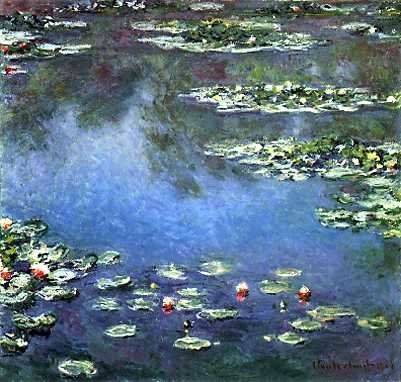
Claude Monet's 'Water Lillies' (1920) and Chuck Closes' 'Maggie' (1998)


Maggie, (1996), Oil on canvas, 30 x 24"
(76.2 x 61 cm), Photograph by Ellen Page Wilson, courtesy of PaceWildenstein, New York, © Chuck Close 
Self Portrait (1994). Chuck Close. Detail.
Water Lillies (1920) Claude Monet
Water Lillies (1920) Claude Monet.

Both Claude Monet and Chuck Close were exploring paint, colour and human perception. Research the work of both artists in order to;


1. Outline the intentions of each artist.


A: Chuck Close said: "he building blocks for my paintings are not symbolic. They don't stand for anything. It's a little bit like an architect ? picking up a brick. You stack up the bricks one way, you get a cathedral. You stack up the bricks another way, and you get a gas station." And the painting is his daughter Maggie. All his work is beside on photos, he took a photo first, and then do the work.

Claude Monet: All his paintings are around his own life, its most about the event or nature surrounding him. He said :Last autumn I burned six paintings with the dead leaves from my garden. It is enough to make you lose all hope. Yet I would not want to die without having said everything I have to say, or at least tried to say. And my days are numbered... Who knows what tomorrow will bring...(Water-lily serie painting in Giverny)

Both Claude Monet adn Chuck Close are afraid about death, they have hope to being alive. All those painting show the hope and the important things during their lives.

2. Describe the techniques of each artist


A: Chuck Close use photography and oil on canvas. His portraits, the photos, and canvases were gridded off by assistants and then he used his mouth brush to paint, using the techniques of grisaille and pointillism within the grids. This is similar to technique used by the Impressionists and Pointillists. The result was still a canvas of mini-paintings, which when viewed from a distance are seen as a single or unified image.

Monet just painting like photos.
The painting technique fundamental to Impressionism is that of broken color, which is supposed to achieve the actual sensation of light itself in a painting. Monet worked primarily in oil paint, but he also used pastels and carried a sketchbook. He used quite a limited range of colors in his paintings, banishing browns and earth colors from his palette. By 1886, black had also disappeared.Asked in 1905 what colors he used, Monet said: "The point is to know how to use the colors, the choice of which is, when all is said and done, a matter of habit." (Boddy,M.)


3. Find 2 quotes about each artists work, and reference them correctly.

Emma, 2002
Chuck Close (American, born 1940)
113-color Japanese-style 
ukiyo-ewoodcut; 43 x 35 in. (109.2 x 88.9 cm), framed dimensions: 45 5/8 x 37 1/4 x 2 1/8 in. (115.9 x 94.6 x 5.4 cm)
Edition of 55
Printer: Pace Editions Ink, New York (Yasu Shibata)
Publisher: Pace Editions, Inc., New York
Courtesy of Pace Editions, Inc., and the artist
Pace Editions, Inc., New York, publisher
Courtesy of Pace Editions, Inc. and the artist


Water Lilies(1906)

100% HAND PAINTED cheap OIL PAINTING

Painted Size : 20*24inch
24*36inch
36*48inch
Medium : Oil Paint on Canvas
Condition : Brand New
Frame Type : NOT Ready to hang


4. Note 3 similarities of the work of both artists.

A:They all scared about death.
They all painted the real things around their lives.
The colors they used are bright and are oil.

5. What are some differences between the artist's work. (at least 3)

A: Chuck like to take a photo before paint.
And they use the different techniques.
The paintings from Chuck are more about people, and those are portraits.
Monet paint the nature where he used to be there.

6. Describe your response to the work of both artists.

A: In my opinion, I prefer Monet's work more then Chuck's. I love nature and the landscape. Chuck's works are more abstract. They all have level of painting skill. From their works, the modernism and post-modernism not only shows the differences between colors, but also the style of the works.

7. Add any other comments you would like.

A: Modernism, in my opinion, means the works that I cannot understand easily, the works have to be "read" deeply. However, works relate to both Modernism and Post-Modernism are delicate enough.

8. Comment on other students' blogs.


Reference List:


Boddy,M.  
       http://painting.about.com/od/oldmastertechniques/a/painting_Monet.htm


Water-lily serie painting in Giverny, Claude MONET Paintings, Paintings, Pictures. Posters and Prints
       http://www.intermonet.com/oeuvre/nymphea2.htm


http://www.artsconnected.org/artsnetmn/identity/close.html


www.whitecube.com/exhibitions/close/paintings-i/


http://www.moma.org/collection/object.php?object_id=80220


http://www.worcesterart.org/Exhibitions/Past/close.html


This is the final blog posting for assessment, and must be completed by 31/5/11 10am.

Week 7-Industrialisation and Cao Fei's RMB City

Dynamism of a dog on a Leash (1912) Giacomo Balla

Industrialisation in the late 1800s, and today.

RMB City (2007-9)  Cao Fei


The artists of the late 1800's and early 1900's, in Europe, were influenced by the Industrial revolution.

1. What and when was the Industrial Revolution?

A:During the 1800s the Industrial Revolution spread throughout Britain. The use of steam-powered machines, led to a massive increase in the number of factories (particularly in textile factories or mills)(Nettlesworth Primary School).
The Industrial Revolution marks a major turning point in human history; almost every aspect of daily life was influenced in some way. Most notably, average income and population began to exhibit unprecedented sustained growth. In the two centuries following 1800, the world's average per capita income increased over 10-fold, while the worlds population increased over 6-fold(Maddison, A. 2003).

Both paintings featured on this blog, that are from the early 1900s were painted by Modernist painters from the group called 'Futurists'. The Futurists celebrated the machine, and objects in motion. Their primary objective was to depict movement, which they saw as symbolic of their commitment to the dynamic forward thrust of the 20th century.

2. Research both Modernist paintings in order to comment on the subject matter, form and style used to celebrate the machine and motion in each painting. Answer the question in 2 parts for each painting.

A: Futurism spanned from approximately 1910 to 1930, and originated in Italy, although there were parallel movements elsewhere. Futurism is one of the movements that developed during the Modern Art period, alongside other movements like Cubism(Wildy,J. 2010)
The transition between the 19th and 20th century has brought further development of modernistic ideas, concepts and techniques in art. Inspired by Cezanne’s idea, saying that all nature objects can be illustrated with just three geometrical figures: cube, sphere and cone.The industrial revolution and the early 20th century introduced fauvism with its expressively vivid colors verging on aggression in the works of Henri Matisse, Andre Derain, Maurice de Vlaminch and Raoul Dufy. Italian artists, refusing everything with old roots and inspired by the rapid development of technology, appearance of first cars and airplanes, developed in their turn the art movement under the name “futurism”. (Paul Viluda,2010)

Part One. The size of  this painting is :Width: 301 cm ; Height: 200 cm. Using the warm color and a part of blue.  Boccioni said:  "A painting three meters by two in which I attempted and shows the great power within the human body.   a great synthesis of labor, light, and movement . . .It is done completely without models, and all the tricks of the trade are sacrificed to the ultimate cause of emotional expression." The way he draw the painting perfectly shows the movement. Also, the bright color  is relate to Modernist.  The work depicts the labours of men on a construction site utillsing the power of hourses in their labours. It is the power taht appears to be the central focus of the painting as the strong hours in a dominating position filling the centre of the composition.

Part Two, Dynamism of a dog on a Leash from Balla describe a women and her dog are walking on the road. It also shows the movement from using the repeat and locus. The movement also shows the energy.And in the early 20th century, it was through the example of chronophotography that the effect finally made its way onto canvas. The wish to imitate the machine and the mechanised image seduced the would-be modern artist. We find oil paintings doing something that they had never done before – using multiple limbs to indicate bodies in motion. It appears in Marcel Duchamp's Nude Descending a Staircase and in the works of the Italian Futurists. Giacomo Balla's Dynamism of a Dog on a Leash is one of the most striking. (Rinaudo, 2010)

Cao Fei's RMB City (2007-9) refers to China's recent rapid industialisation and urbanization.(www.artspace.org.nz/exhibitions/2009/cafeintopia.asp)
3. Research Cao Fei's 
RMB City (2007-9)  in order to comment on this work in more depth.
i.e what images has she used in her digital collage that refer to China's present and history, and why has she used these.

A: RMB City is an art community in the 3-D virtual world of Second Life, which is an online platform that has amassed 14 million registered users. The project explores the potential of an online art community, seeking to create the conditions for an expansive discourse about art, urbanism, economy, imagination and freedom. (Serpentine Gallery). In the work, it shows the flag of China, the development, Tower form Shanghai, the panda, and the buddha. 


4. 
RMB City is described as a utopia/dystopia. Comment on what these terms mean, and how they can be applied to the work.
A:One of the first art projects taking place in RMB City is Master Q’s Guide to Virtual Feng Shui by Huang He, a young artist who brings the ancient Chinese spatial methodology into the new virtual metaverse of RMB City.Reflecting on China’s recent urban and cultural explosion, the architecture of RMB City is an amalgam of ancient and modern Chinese icons from the panda to the Beijing National Stadium for the 2008 Olympics(Serpentine Gallery). All of these architectures mean here is China, some of the buildings are in Beijing, and some of buildings are in Shanghai. RMB is the money in China. The panda and the Flag is typically means China. Cao Fei mixed them all together to show: This is China. Also, the 3-D display the movement of the work.

5. Although the Modernist paintings and the contemporary digital work have emerged from
different contexts, there are also many similarities. Comment on the similarities that you can see in the work. Look at the moving digital image at 
vimeo.com/4272260, if you have not
already researched it.

A: The video shows the movement by using the 3-D. All the items are relates to China, not only the typical buildings, but also the animals. I think the similarity between this video and the industrialism is the showing the movement, and also the Futurism.

6. Comment on other student's blogs.
Reference List:

Nettlesworth Primary School,  Child Labour & The Industrial Revolution,
         http://www.nettlesworth.durham.sch.uk/time/victorian/vindust.html

Maddison, Angus (2003). The World Economy: Historical Statistics. Paris: Development Centre, OECD. pp. 256–62

Viluda,P. (2010). Modern Art- Revolutionfrom dawn to dusk,
          http://www.cruzine.com/2010/08/17/modern-art/

Wildy,J.(2010). Fururism and Umberto Boccioni's The City Rises,
         http://www.suite101.com/content/futurism-and-umberto-boccionis-the-city-rises-a280519

Rinaudo,D (2010). Giacomo Balla: Dynamism of a dog on a leash.
         http://www.scienceandart.info/index.php?option=com_content&view=article&id=145:giacomo-balla-dynamism-of-a-dog-on-a-leash&catid=57:artworks&Itemid=97

www.artspace.org.nz/exhibitions/2009/cafeintopia.asp
www.artchive.com/artchive/B/boccioni/boccioni_city.jpg.html
www.artchive.com/artchive/B/balla.html 
vimeo.com/4272260